Why Understanding Behavior Training for Dogs Matters
Behavior training for dogs is a specialized approach addressing the emotional and psychological reasons for problem behaviors like aggression, fear, anxiety, and reactivity. Unlike obedience training, which teaches commands like “sit” or “stay,” behavior training changes how your dog feels about a situation and helps them respond in healthier ways.
Quick Answer:
- What it is: Training that modifies a dog’s emotional responses and unwanted behaviors through proven methods like desensitization, counterconditioning, and positive reinforcement
- When you need it: For issues like aggression, separation anxiety, excessive barking, resource guarding, or fear-based behaviors
- Who can help: Certified dog trainers (CPDT), applied animal behaviorists, or veterinary behaviorists
- How it works: By changing your dog’s associations with triggers and rewarding calm, appropriate responses
Most dog owners face some kind of behavior challenge in their dog’s lifetime. Maybe your pup growls when someone approaches their food bowl. Or they bark and lunge at other dogs on walks. Perhaps they destroy the house when you leave for work. These aren’t obedience problems—they’re behavior problems, and they need a different approach.
Here in the Austin area, we understand that a well-behaved dog means more freedom for both of you. More visits to local dog parks. More confidence on the trails. More peace of mind when friends come over. That’s what behavior training offers: not just a dog who follows commands, but a dog who feels safe, confident, and comfortable in their world.
The good news? With the right guidance and consistent practice, most behavior issues can improve significantly. Some dogs just need help learning that the world isn’t as scary as they thought. Others need to understand that calm behavior gets them what they want. They all deserve patient, positive training that builds trust, not fear.
Behavior training for dogs word roundup:
First Things First: Is It Behavior or Just Bad Manners?
It’s a question we hear often: “Is my dog just being stubborn, or is there something more going on?” It’s easy to confuse a dog’s refusal to “sit” with a dog who’s terrified of loud noises. But understanding the difference between obedience and behavior training is the first step to helping your furry friend thrive.
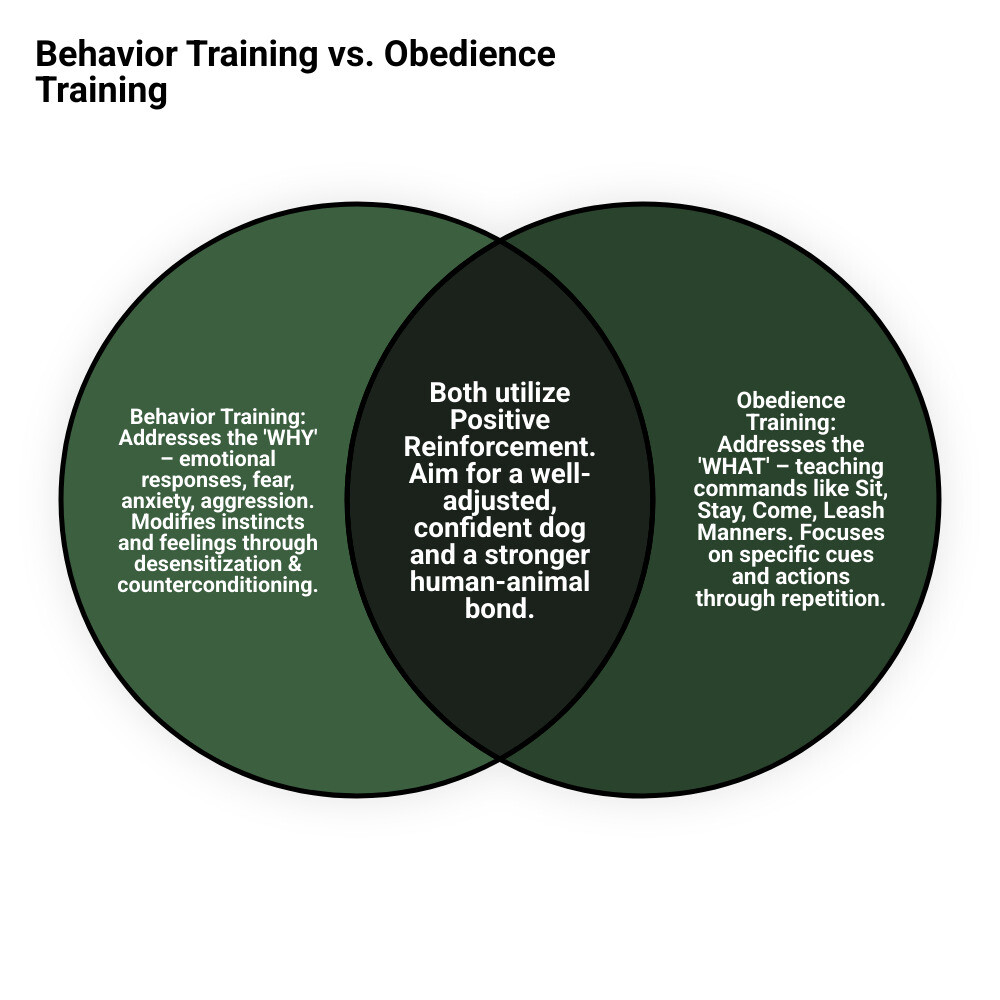
Obedience and behavior training both fall under “dog training,” but they address different aspects of your dog’s learning and emotional landscape. Think of it this way: obedience training teaches your dog the “what” – what to do when you ask. Behavior training addresses the “why” – why your dog acts a certain way and how to change their underlying feelings and reactions. Many dog owners, approximately 80% according to some experts, initially seek obedience training when their dog actually needs behavior training for dogs. This highlights a common misunderstanding that we’re here to clear up!
Obedience Training: The “What”
Obedience training is all about teaching your dog to reliably respond to verbal commands and cues. It’s about building a common language and understanding with your pup. When we teach a dog to “sit,” “stay,” “come,” or to walk politely on a leash, we are engaging in obedience training. These are important life skills that help your dog steer our human world safely and politely.
For instance, basic training focuses on these foundational commands. It’s about compliance and following directions, ensuring your dog understands and acts upon your requests. This training strengthens the bond between you and your dog, making daily interactions smoother and more enjoyable. It helps your dog understand what’s expected of them in various situations, like waiting patiently at the door or greeting guests politely.
Behavior Training: The “Why”
Behavior training for dogs, often called behavior modification, digs deeper than just commands. It focuses on understanding and changing your dog’s emotional responses and ingrained instincts. If your dog is struggling with fear, anxiety, or aggression, simply telling them to “sit” won’t address the root cause of their distress. Behavior training aims to modify these underlying feelings and associations.
This approach acknowledges that many challenging behaviors stem from how a dog feels about a situation. For example, a dog who lunges and barks at other dogs on leash isn’t necessarily being disobedient; they might be fearful or anxious. Behavior training uses specialized techniques like counter-conditioning and systematic desensitization to help your dog change their emotional association with triggers, ultimately building their confidence and allowing them to respond in more appropriate ways. It teaches them which behaviors “work” (lead to positive reinforcement) and which don’t, even without a direct command.
When is Behavior Training for Dogs Necessary?
So, how do you know if your dog needs obedience training or the more specialized approach of behavior training for dogs? Here’s a simple table to help you decide:
| Scenario | Obedience Training Needed? | Behavior Training Needed? |
|---|---|---|
| Puppy learns “sit” and “stay” | Yes | No |
| Dog pulls on leash during walks | Yes | Maybe |
| Dog growls when approached while eating | No | Yes |
| Dog jumps on guests consistently | Yes | Maybe |
| Dog barks excessively at every noise | No | Yes |
| Dog is anxious when left alone | No | Yes |
| Dog shows fear of strangers | No | Yes |
| Dog darts out the door every time it opens | No | Yes |
| Dog chews inappropriate items | No | Yes |
| Dog needs to learn to come when called | Yes | No |
As you can see, if the issue stems from an emotional response, a strong instinct, or a deeply ingrained habit, behavior training for dogs is likely the path to a happier, calmer companion.
Decoding Your Dog’s Actions: Common Issues and Their Roots
Understanding why your dog does what they do is like being a detective with a tail-wagging partner. Many behaviors that are completely natural for dogs—like barking, digging, or chewing—can become challenging for us pet parents. The good news is most dog owners face a behavior issue in their dog’s lifetime, so you’re not alone on this journey.
Before we jump into any training, it’s always wise to rule out any underlying medical causes. A dog who suddenly starts urinating indoors, for example, might have a urinary tract infection rather than a training problem. A visit to your veterinarian is always the first step when you notice a sudden change in behavior. Once medical issues are off the table, we can start looking at common problems, identifying their triggers, and understanding their roots in fear, anxiety, boredom, or lack of socialization. The ASPCA has a great resource on common dog behavior issues that can help shed light on many of these challenges.
Common Behavior Challenges
Some issues pop up more frequently than others, and they can range from mildly annoying to downright serious. Aggression, for instance, is not only the most common but also the most serious behavior problem in dogs. But it’s not the only one that can cause concern.
Here are some common behavior challenges that often require specialized behavior training for dogs:
- Aggression: This can manifest in many forms—towards people, other animals, or even over resources. Different forms of aggression require different treatments, and address this with expertise. For more in-depth information, you can explore resources like our guide on behavior modification for aggressive dogs.
- Separation Anxiety: Many dogs become destructive or disruptive when left alone. This isn’t out of spite, but often due to genuine distress.
- Excessive Barking: Dogs bark for many reasons—excitement, fear, boredom, attention-seeking, or territoriality. Identifying the “why” behind the bark is key.
- Resource Guarding: This is when a dog growls, snarls, or snaps when someone approaches their food, toys, or even their bed. It can range from benign to aggressive.
- Leash Reactivity: This often looks like aggression on walks (barking, lunging at other dogs or people), but it’s frequently rooted in fear, frustration, or over-excitement.
- Destructive Chewing: While chewing is a natural and necessary behavior for dogs, they need to learn what is and isn’t acceptable to chew on. Boredom, anxiety, or puppy teething can all lead to destructive chewing.
- Mounting and Humping: These are normal dog behaviors, but they can be curbed if they become problematic or excessive.
Getting to the Bottom of It
Identifying the root cause of a dog’s behavior issue requires keen observation and sometimes, a little detective work. Start by observing your dog closely. When does the behavior occur? What happens right before it (the trigger)? What happens immediately after (the consequence)? Keeping a journal can be helpful.
As we mentioned, consulting a veterinarian is paramount. They can diagnose or rule out medical conditions that might be causing or exacerbating behavioral changes. For example, a sudden onset of aggression could be linked to pain, or increased anxiety to a thyroid issue.
Beyond health, consider environmental factors and changes in routine. A new baby, a move, a change in your work schedule, or even a new piece of furniture can all impact a sensitive dog. Understanding dog body language is also important. Subtle cues like a lip lick, a yawn, a whale eye (when the whites of their eyes show), or a tucked tail reveal how your dog is feeling long before they resort to more obvious behaviors. By understanding their subtle signals, we can intervene early and provide support.
The Trainer’s Toolkit: Methods Used in Behavior Training for Dogs
When it comes to behavior training for dogs, our approach is rooted in solid learning theory, focusing on positive, humane methods that build trust and make training a joyful experience. We believe in creating happy Tail Wags, not fear or intimidation. The science behind how dogs learn, known as operant conditioning, guides our every step. We want to encourage your dog to make good choices, not just follow orders. For a deeper dive into the science, the AKC offers insights into positive reinforcement dog training and operant conditioning.
The Power of Positive Reinforcement
At the heart of effective behavior training is positive reinforcement. This method involves adding something your dog loves, like a delicious treat, praise, or a favorite toy, immediately after they perform a desired behavior. The goal is simple: to increase the likelihood of that good behavior happening again. It’s not a bribe; it’s an effective, science-based way to show your dog they did something right!
Positive reinforcement training is effective and humane. It strengthens the bond between you and your dog because they associate you with good things. Your dog becomes an active, eager participant in the training process, not just a passive recipient of commands. We’ve seen how this approach helps dogs change, making them more confident and willing to try new things. It fosters a love for learning and encourages them to offer behaviors, rather than waiting for you to tell them what to do.
Desensitization and Counterconditioning
For dogs with fear, anxiety, or reactivity, two effective techniques are desensitization and counterconditioning. These methods are about changing how your dog feels about a particular trigger.
- Desensitization involves gradually exposing your dog to the thing they fear, but at such a low level that it doesn’t cause them distress. Imagine a dog terrified of thunderstorms. We might start by playing a recording of thunder at a volume so low they barely notice it, slowly increasing it over many sessions. This helps them habituate to the sound without becoming overwhelmed.
- Counterconditioning works hand-in-hand with desensitization. While gradually exposing your dog to the trigger, we simultaneously create a positive association. For our storm-fearing friend, as the low-level thunder plays, we’d offer their favorite high-value treats or engage in a fun game. The goal is to change their emotional response from “thunder = scary” to “thunder = yummy treats and fun!” It’s about teaching them to replace an unwanted behavior with a more favorable one.
These methods require patience and consistency, but they are effective at helping anxious dogs overcome their fears and build confidence.
Other Gentle Techniques
Beyond these, we use other gentle, effective techniques based on how dogs naturally learn:
- Negative Punishment: Don’t let the word “punishment” scare you here! In this context, negative means removing something, and punishment means decreasing a behavior. So, negative punishment means removing something your dog likes to decrease an unwanted behavior. For example, if your dog jumps on you for attention, you might calmly turn your back and walk away (removing your attention). Once all four paws are on the floor, attention is given.
- Extinction: This involves ignoring a behavior that was previously reinforced, causing it to eventually stop. For instance, if your dog barks for attention and you consistently ignore it, the barking will likely increase initially (an “extinction burst”) before it eventually decreases and stops.
- Shaping: This is a fantastic technique for teaching complex behaviors by breaking them down into tiny, achievable steps and rewarding each successive approximation. The AKC offers great insights into shaping. For example, to teach your dog to lie down, you might first reward them for looking at the floor, then for lowering their head, then for a partial crouch, and finally for a full lie-down. This way, your dog figures out the behavior themselves, which is a great confidence-builder for them!
- Lure-and-Reward Training: This is a simple and effective way to teach new behaviors by using a treat to guide your dog into the desired position. The key is to quickly “fade the lure” so your dog isn’t reliant on seeing a treat in your hand. You want them to perform the behavior on a verbal cue or hand signal alone, with the reward appearing after they’ve done it.
These methods, when applied consistently and with a deep understanding of your dog’s individual needs, create a positive and effective learning environment.
Finding the Right Guide: Choosing a Professional and Training Format
Starting on behavior training for dogs is a big step, and finding the right professional to guide you is paramount. It’s like finding a trusted friend who speaks “dog” and can help bridge the communication gap. Here in the Austin area, we believe in connecting you with the best fit for your dog’s unique personality and challenges.
Vetting professionals, asking the right questions, and finding someone whose philosophy aligns with yours are key to a successful journey. We’re all about Hands-On Care and ensuring your dog feels safe and understood throughout the process.
Types of Behavior Professionals
The world of dog behavior professionals can feel like the wild west, with many different titles. It’s important to understand the distinctions based on their education, experience, and scope of practice:
- Dog Trainers: This is a broad category, and their qualifications can vary widely. While many are excellent for basic obedience and minor behavior issues, their education and experience can differ significantly.
- Certified Professional Dog Trainers (CPDTs): These individuals have typically passed an independent certification exam (like those from the Certification Council for Professional Dog Trainers, CCPDT) demonstrating a certain level of knowledge and experience in dog training and behavior. They adhere to a code of ethics and use humane, science-based methods.
- Applied Animal Behaviorists (CAABs/ACAABs): These professionals usually hold advanced degrees (MS, MA, or PhD) in animal behavior. They are experts in behavior modification, understanding normal species behavior, and teaching/counseling pet owners.
- Veterinary Behaviorists (Dip ACVBs): These are veterinarians who have completed specialized residencies in animal behavior. They are uniquely qualified to diagnose and treat behavioral issues from both a medical and behavioral perspective, and can prescribe medication when necessary. They are invaluable for complex or severe cases, especially those with a potential medical component.
For issues requiring specialized behavior training for dogs, we often recommend seeking out professionals with certifications or advanced degrees, as they have a deeper understanding of the “why” behind challenging behaviors.
Finding the Right Professional for Behavior Training for Dogs
Choosing the right partner for your dog’s behavior journey is a big decision. Here are some questions to ask potential trainers or behaviorists to ensure a good fit:
- What are your certifications and educational background in dog behavior?
- What methods do you use for behavior training for dogs? (Look for positive reinforcement, desensitization, counterconditioning.)
- How do you address specific issues like aggression or separation anxiety?
- Can you provide references from past clients?
- What is your experience with my dog’s specific breed or type of issue?
- Do you involve the owner heavily in the training process? (A good professional will teach and support you!)
- How do you handle situations where a dog might be stressed or uncomfortable during training?
Red flags to watch for:
- Trainers who offer “guarantees” of success (behavior is complex, and no one can guarantee an outcome).
- Those who object to using food rewards (food is a strong, natural motivator).
- Professionals who rely heavily on aversive tools like choke chains, prong collars, or shock collars, or who use harsh physical corrections.
- Trainers who don’t explain their methods clearly or make you feel uncomfortable.
Always trust your gut feeling. The right professional should be patient, clear, and focused on building a positive relationship with both you and your dog.
Choosing a Training Format
Once you’ve identified the type of professional you need, you’ll want to consider the best training format for your dog and your lifestyle. Options vary, and each has its benefits:
- Group Classes: Great for basic manners and socialization, especially for puppies. These provide a controlled environment for your dog to learn around distractions. However, they may not be suitable for dogs with significant fear or reactivity issues.
- Private In-Home Sessions: Ideal for specific behavior problems or for dogs who are easily overwhelmed in group settings. The trainer comes to your home, allowing for personalized attention and addressing issues in the environment where they occur.
- Day Training: With day training, a professional works with your dog one-on-one during the day, often while you’re at work. This can be a great option for busy pet parents in Austin, Lakeway, or Bee Cave. The trainer might work on specific skills or behavior modification, then transfer those skills to you.
- Board and Train Programs: For more intensive behavior training for dogs, a board and train program can be effective. Your dog stays with a professional trainer for a period, receiving consistent, immersive training. When considering a board and train Austin option, it’s important that the program includes owner instruction so you can maintain the learned behaviors at home.
At Pet Caddy, we’re proud to offer a unique “Ranch Adventure” experience for our board and train programs, available to families across the Austin area, including Spicewood, Horseshoe Bay, Marble Falls, Steiner Ranch, Hudson Ranch, Barton Creek, and Barton Creek Lakeside. Our 5-acre ranch provides Wide Open Spaces for learning and play, unlike traditional kennels. Dogs are never confined all day; they’re out playing, exploring, and receiving consistent, Supervised training and Custom Play. We provide a “Like Home” environment, ensuring peace of mind for you and a stress-free, enriching experience for your dog. Our pricing is transparent with no hidden fees, and Hands-On Care and all-day play are always included at no extra cost.
Frequently Asked Questions about Dog Behavior Training
We know you’ve got questions, and we’re here with answers! Behavior training for dogs is a journey, and understanding what to expect can help you feel more confident and prepared.
How long does behavior training take?
This is perhaps the most common question we hear, and the honest answer is: it varies! Just like people, every dog learns at their own pace. Factors like your dog’s age, past experiences, the severity of the issue, and your consistency at home all play a role. Some owners in Austin, Spicewood, or Lakeway might notice improvements in just a few sessions with consistent practice, especially for minor issues. For more deeply ingrained or serious challenges, it can take weeks or even months of dedicated effort.
Patience and consistency are key, as training is cumulative. It’s often a lifelong process of reinforcing good habits and maintaining a healthy emotional balance. Think of it as investing in a happier, more harmonious life together.
Can you teach an old dog new tricks (and behaviors)?
Absolutely, yes! The old adage “you can’t teach an old dog new tricks” is simply not true when it comes to behavior training for dogs. Dogs, regardless of age, have adaptable brains and are capable of learning new behaviors and modifying old ones. We’ve seen incredible changes in older dogs here in the Austin area.
It might take a bit more patience and creativity to modify deeply ingrained habits, but with positive methods and a consistent approach, older dogs can make significant progress. It’s never too late to start building confidence and teaching new skills, whether your furry friend is a wise senior in Marble Falls or a seasoned companion in Bee Cave.
Is behavior training expensive?
Investing in behavior training for dogs is an investment in your peace of mind and your dog’s well-being. The cost varies depending on the professional, training format (group classes, private sessions, board and train), and the severity of the issue.
While some upfront costs might seem daunting, consider the long-term value. Addressing behavior issues can prevent costly property damage, vet bills from stress-related illnesses, or even the heartbreaking decision to rehome a beloved pet. For specific pricing on our programs here in the Austin area, including our unique Ranch Adventure board and train, we believe in transparent pricing with no hidden fees. Services like Hands-On Care and all-day play are always included. We encourage you to explore dog training Austin prices and discuss your budget and goals with us. We’re confident the benefits far outweigh the costs.
A Happier Hound and a Happier You
The journey of behavior training for dogs is one of the most rewarding things you can do for your companion and yourself. It’s about more than managing problems; it’s about fostering a deeper understanding, building a strong bond, and helping your dog become a well-rounded companion.
When your dog feels safe, confident, and understood, you gain increased safety, more freedom to enjoy life together, and priceless peace of mind. Imagine leisurely strolls through the parks of Lakeway, confident visits with friends in Horseshoe Bay, or simply a calm and joyful home in Steiner Ranch. That’s the Pet Caddy promise.
Our approach to dog training services focuses on nurturing a well-rounded companion. We believe every dog deserves a “Like Home” experience, especially when they’re learning and growing. With our unique Ranch Adventure programs on five acres of Wide Open Spaces, your dog gets the personalized attention and stimulating environment they need to thrive. We’re here to help you and your dog write a happier, healthier chapter together.
Ready to start your dog’s behavior training journey? Let’s chat about how we can help your dog wag their tail with confidence!