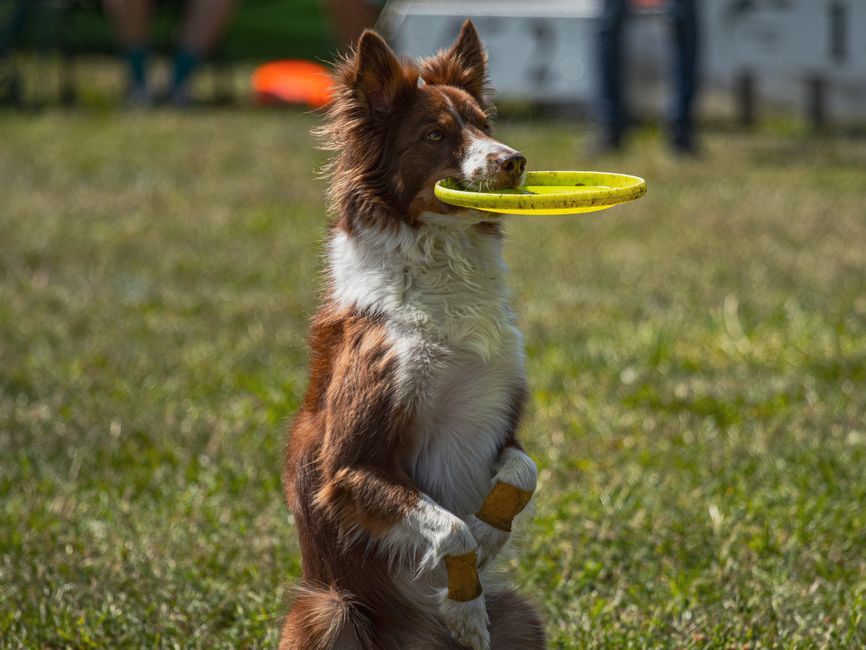
What Are the Best Border Collie Tricks to Teach?
If you’re looking for the best border collie tricks to teach your dog, here’s a quick list to get you started:
- Fetch – Retrieve and return a toy on command
- Paw shake – Lift and place paw in your hand
- Roll over – Full body roll from a down position
- Play dead – Drop and stay still on cue
- Speak / Quiet – Bark or stop barking on command
- Hoop jumping – Leap through a held or standing hoop
- Leg weaving – Weave between your legs while walking
- Bow down – Front legs drop, rear stays up
- Crawl – Move forward from a flat down position
- Sit pretty – Balance upright on hind legs
- Back-up – Walk backward on cue
- Cup switcheroo – Find the hidden treat under a cup
- Wait for it – Hold position until released
- Jump – Leap over an obstacle on command
- Choreographed dance – Linked sequence of spins, weaves, and stands
Border Collies are ranked the number one most intelligent dog breed — and that working brain needs a job. Without one, it’ll find its own. And trust us, you won’t love the job it picks.
These dogs were bred to manage hundreds of sheep across rough terrain, reading signals and making split-second decisions all day long. That drive doesn’t disappear just because the sheep are gone. It just looks for somewhere else to go.
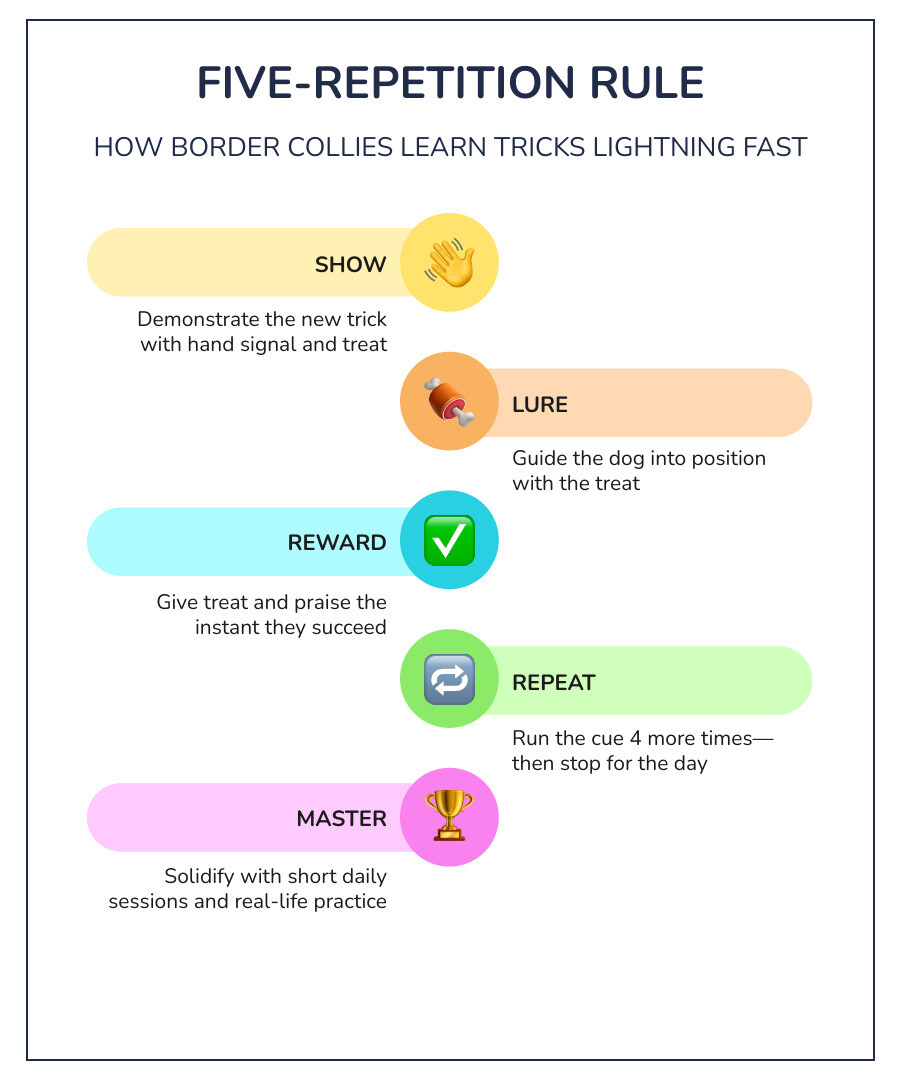
The good news? Trick training is one of the best outlets you can give them. Border Collies can learn a new command in as few as five repetitions — far faster than most breeds. That means you’ll see real progress quickly, and your dog will stay genuinely engaged rather than bored and restless.
Whether your Border Collie is a puppy just finding their feet or a seasoned adult with a few bad habits, teaching tricks builds focus, burns mental energy, and deepens the bond between you two. It’s hands-on care for your dog’s brain — and it doesn’t cost a thing but your time.
Border collie tricks basics:
Why Border Collie Tricks Are the Secret to a Happy Home
A Border Collie with no job is a self-appointed household manager. Sometimes that means chasing shadows, reorganizing your socks, or herding the kids down the hallway like tiny sheep.
That is why trick training matters.
For this breed, tricks are not just party pieces. They are mental work. Research and breed experts consistently point to the same thing: Border Collies need daily thinking tasks, not just more running. In fact, many do best with 30 to 60 minutes of mental work each day, mixed with physical activity. If they only get exercise, they often become fitter without becoming calmer.
Their herding instinct plays a big role here. Border Collies were bred to watch movement, read patterns, and respond fast at a distance. That makes them brilliant at learning cues, hand signals, sequences, and behavior chains. It also means they may fixate on joggers, bikes, kids, cats, or anything else that moves. Trick training helps redirect that instinct into structured games with rules.
It also helps prevent boredom. A bored Border Collie can become barky, mouthy, destructive, or obsessive. Teaching tricks gives them a clear outlet for that brainpower and helps you stay one step ahead.
And just as important, trick work builds your relationship. Every session teaches your dog that paying attention to you is rewarding. That matters whether you are practicing in the backyard, in your living room, or looking for dog training in Lakeway, Bee Cave, or the greater Austin area.
If your dog needs a stronger foundation first, start with basic dog commands. And if you need inspiration for giving your dog meaningful “jobs” around the house, this story about a Border Collie put to work at home shows just how far that work ethic can go.
15 Impressive border collie tricks to Start Today

Here are 15 fun, useful, and downright impressive tricks that suit the Border Collie brain.
-
Fetch Teach your dog to chase, pick up, return, and release a toy. This is a classic because it channels focus and self-control. Do not reward keep-away.
-
Paw shake Easy to teach and great for building confidence with targeting one paw at a time.
-
Roll over A solid beginner-to-intermediate trick that improves body awareness.
-
Play dead Usually taught from a down or side position. Dramatic. Silly. Always a crowd-pleaser.
-
Wait for it This teaches impulse control before food, toys, doors, or throws.
-
Jump A simple jump over a low bar or object can become the base for agility-style work.
-
Quiet Helpful for dogs who like to announce every squirrel, delivery truck, and floating leaf.
-
Speak Useful when taught thoughtfully. Reward one or two barks, then stop. Do not accidentally build nonstop barking.
-
Hoop jumping A fun progression from a regular jump. Great for athletic adult dogs.
-
Back-up Walking backward teaches rear-end awareness and concentration.
-
Leg weaving Your dog weaves through your legs while you step forward. It looks fancy and builds coordination.
-
Cup switcheroo Also called a shell game. Hide a treat under one cup, move the cups, and ask your dog to find it. This is mental gold for problem-solvers.
-
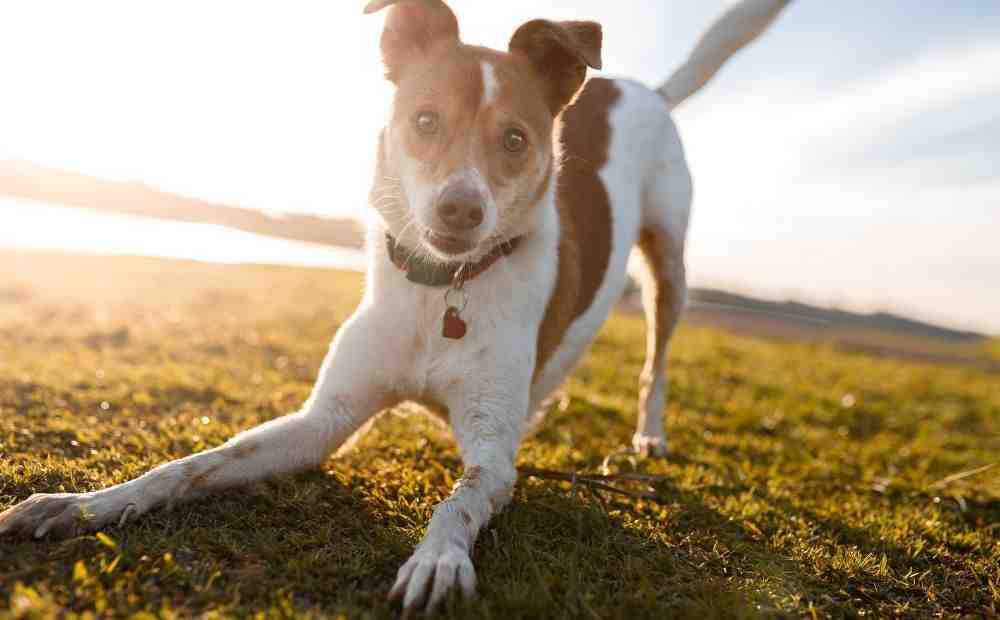
Bow down Front end low, rear end high. Cute and useful as a stretch after exercise.
-
Crawl A slow, controlled move from the down position that takes patience and body control.
-
Sit pretty Balancing upright on hind legs looks adorable, but it is physically demanding, so save it for dogs with good core strength.
If you want a second list of ideas, this roundup of fun trick ideas for Border Collies covers many of the same favorites.
Teaching Basic border collie tricks
The fastest way to teach most Border Collie tricks is to keep it simple:
- Start with a behavior your dog already knows, like sit, down, stand, or stay
- Use a lure, target, or hand signal to guide the movement
- Mark the correct action right away with praise or a marker word
- Reward immediately
- Repeat in short sessions
- Add the verbal cue only after the movement is consistent
Here is how to teach the most common basics:
Fetch
- Reward interest in the toy.
- Reward picking it up.
- Reward holding it for a second.
- Encourage one step toward you.
- Trade for a treat when your dog releases.
- Gradually increase distance.
If your dog grabs the toy and runs off, do not turn it into a chase game. Use a long line if needed and reward the return and release, not the victory lap.
Paw shake
- Ask for sit.
- Hold a treat near your dog’s paw.
- Wait for any paw lift.
- Mark and reward.
- Present your hand.
- Reward when the paw touches your hand.
- Add the cue “shake” or “paw.”
Roll over
- Start in down.
- Lure your dog’s nose toward the shoulder.
- Continue the lure so the body tips onto one side.
- Guide the lure over the back so your dog completes the roll.
- Reward the full motion.
- Fade the lure over time.
Play dead
- From down, lure onto one hip.
- Reward lying on the side.
- Add stillness for one second, then longer.
- Add a cue like “bang” or “play dead.”
For more on building reliable mechanics and clearer communication, see advanced training skills.
Advanced border collie tricks for Your Resident Genius
Once your dog understands shaping, luring, and following cues, Border Collies can move into surprisingly advanced work.
Choreographed dance
This is one of the most impressive things a Border Collie can learn because it combines multiple moves into a sequence: spins, leg weaves, backing up, standing on hind legs, and moving beside you in rhythm. Viral examples like this dance-performing Border Collie show just how polished these routines can become when trained step by step.
The key is to teach each move separately, then chain them together in tiny pieces.
Scent retrieval
Border Collies are not just visual learners. They can also do excellent scent-based tasks. A fetch story like this ocean ball retrieval highlights the kind of focus and problem-solving they can bring to finding an object even when they cannot see it clearly.
Start with one scented toy, short distances, and an easy search area. Then slowly increase difficulty.
Household chores
Because of their working background, many Border Collies thrive when tricks become practical jobs:
- Put toys in a basket
- Carry a light laundry item
- Close a cabinet with the nose
- Take paper to a bin
- Bring slippers or a leash
These chores can satisfy that “I need employment” mindset in a safe, structured way. This story about a Border Collie doing household tasks is a good reminder that work does not have to involve sheep.
For dogs ready for bigger challenges, our guide to specialty and advanced dog training is a helpful next step.
Training Methods for Success on the Ranch
Training a Border Collie is usually less about motivation and more about management. They are smart enough to learn the right thing fast and the wrong thing faster.
Here is what works best:
Keep sessions short
Think 3 to 10 minutes, especially for brand-new skills. Short sessions keep enthusiasm high and frustration low. Multiple mini sessions each day usually beat one long marathon.
Be consistent
Use the same cue, the same hand signal, and the same rules. If “down” means elbows on the floor today but something else tomorrow, your dog will notice. They are pattern machines.
Train in a low-distraction space first
Start indoors or in a quiet yard. Then add harder environments gradually. A Border Collie who can roll over in your living room may suddenly forget everything when a squirrel appears.
Reward immediately
Timing matters. Border Collies learn quickly, so delayed rewards can accidentally reinforce the wrong moment. Mark the exact behavior you want, then pay for it.
Mix praise and treats
Some Border Collies work for food, some for toys, some for praise, and many for a mix. Keep it lively. They are clever enough to quit boring drills.
Build on prerequisite skills
Before teaching advanced tricks, make sure your dog has a decent sit, down, stay, stand, and recall. That foundation saves everyone a headache. You can also explore dog manners training as part of that groundwork.
Give them purpose
This breed does well when tricks feel like jobs. Retrieving named toys, running to a mat, sorting objects, or completing a sequence can be more satisfying than repeating one simple cue over and over.
Stay calm and clear
Older training language sometimes focuses on being the “alpha.” In practice, what works better is calm leadership, clear boundaries, and consistent follow-through. Border Collies do not need drama. They need direction.
At Pet Caddy, we see this often with active dogs visiting us from Austin, Spicewood, Lakeway, Steiner Ranch, Bee Cave, and nearby communities. They settle best when life includes structure, supervised activity, and hands-on care. Small Groups, Big Care makes a difference, especially for busy working breeds.
Safety and Physical Health During Training
Border Collies are athletic, but athletic does not mean indestructible.
Physical tricks need common sense. A dog can be mentally brilliant and still not be ready for jumping, repeated weaving, or balancing work.
Here are the big safety points:
- Warm up first with easy movement
- Use non-slip surfaces
- Keep jumps low for beginners
- Avoid repetitive impact on hard ground
- Stop if your dog looks sore, stiff, or reluctant
- Do not force uncomfortable positions
- Ask your vet before starting demanding tricks if your dog has a history of orthopedic issues
Backflips and extreme acrobatics may go viral, but they are not a casual weekend project. Even stories about snow flips come with an obvious safety lesson: soft landings matter. For most families, advanced trick work should mean polished skills and clever sequences, not risky stunts.
Puppy vs adult training limits
| Training area | Puppies | Adults |
|---|---|---|
| Basic cues | Great time to start | Great time to refine |
| Short luring sessions | Yes, keep them brief | Yes |
| Low crawl and bow | Usually fine if comfortable | Fine if comfortable |
| Fetch | Short, gentle retrieves | Moderate sessions |
| Jumping | Avoid repetitive jumping until growth plates mature | Fine at sensible heights |
| Hoop jumping | Wait until physically mature | Fine with proper setup |
| Sit pretty | Use caution, short holds only | Fine if back and core are healthy |
| Long drill sessions | Not recommended | Still not ideal |
If your Border Collie is an adolescent, the brain may write checks the body should not cash yet. Keep flashy tricks age-appropriate.
And do not overlook emotional safety either. Training should feel fun, not pressuring. End sessions on a win. If your dog is tired, confused, or over-aroused, take a break.
Frequently Asked Questions about Training
How long does it take for a Border Collie to learn a new trick?
Often, not long at all. Border Collies are famous for learning cues in fewer than five repetitions on average, and some pick up simple movements in two or three tries. That said, “learn” and “perform reliably” are not the same thing.
A simple trick like paw shake may click in one session. A polished fetch, quiet cue, or leg weave with distractions can take days or weeks. A choreographed routine can take much longer because it involves chaining several skills together.
The breed usually learns faster than average, but reliability still comes from repetition, consistency, and practice in different places.
Can I teach an older Border Collie new tricks?
Yes. Absolutely.
Adult and senior Border Collies can still learn well, especially when training is reward-based and broken into small steps. In some ways, older dogs are easier because they often have better focus than puppies.
You may need to adjust for fitness, arthritis, or old habits, but the brain is often still eager for work. Just choose age-friendly tricks. Scent games, object retrieval, targeting, and household jobs are often perfect.
How do I stop my Border Collie from herding the kids?
You usually do not “erase” herding instinct. You redirect it.
Try this approach:
- Interrupt early, before the stare and stalk build momentum
- Call your dog to you and reward heavily
- Use gates or leashes during high-energy times
- Give your dog another job, like mat work, toy retrieval, or a trick sequence
- Practice impulse control cues like wait, down, leave it, and recall
- Make sure your dog gets daily mental work, not just exercise
This matters because herding kids can quickly become nipping, circling, and over-arousal. The fix is structure and redirection, not punishment. If needed, go back to basic commands and build from there.
Conclusion
Teaching border collie tricks is one of the simplest ways to give this breed what it has been asking for all along: a job, a challenge, and time with you.
Whether you start with fetch and paw shake or work up to scent retrieval and dance routines, each trick helps burn mental energy, sharpen focus, and create more Tail Wags at home. For a Border Collie, that kind of thinking work can be just as important as a long walk.
And if you want more support with training, structure, doggy daycare, and supervised activity, we are here for families across Austin, Spicewood, Horseshoe Bay, Marble Falls, Steiner Ranch, Hudson Ranch, Lakeway, Barton Creek, Barton Creek Lakeside, and Bee Cave. At Pet Caddy, dogs get Wide Open Spaces, a Ranch Adventure feel, and Hands-On Care in a Like Home setting. Transparent pricing, Tailored Play, and personal attention make every stay feel comfortable and well-supported.
Ready to give your Border Collie something worthy of that big working brain?
More info about dog training services and schedule your pup’s stay.