Teach Your Hunting Dog ‘Whoa’: Step-by-Step Success
Why ‘Whoa’ Is the Most Important Command You’ll Ever Teach Your Bird Dog
Whoa training a bird dog is the single most important skill you can build with your pointing dog — and getting it right early makes everything else fall into place.
Here’s the short answer if you need it fast:
How to teach your bird dog ‘Whoa’ in 5 steps:
- Start on a bench or table — place your dog, say “Whoa” once, and replace immediately if it moves
- Move to lead work — stop during heel walks, give the command, and correct any movement
- Introduce the whoa post — use a soft rope around the flank to build a clear physical cue for “stop and stand still”
- Proof with distractions — practice in parks, fields, and around birds before hunting season
- Transition to remote tools — once the behavior is solid, layer in an e-collar for off-lead reliability
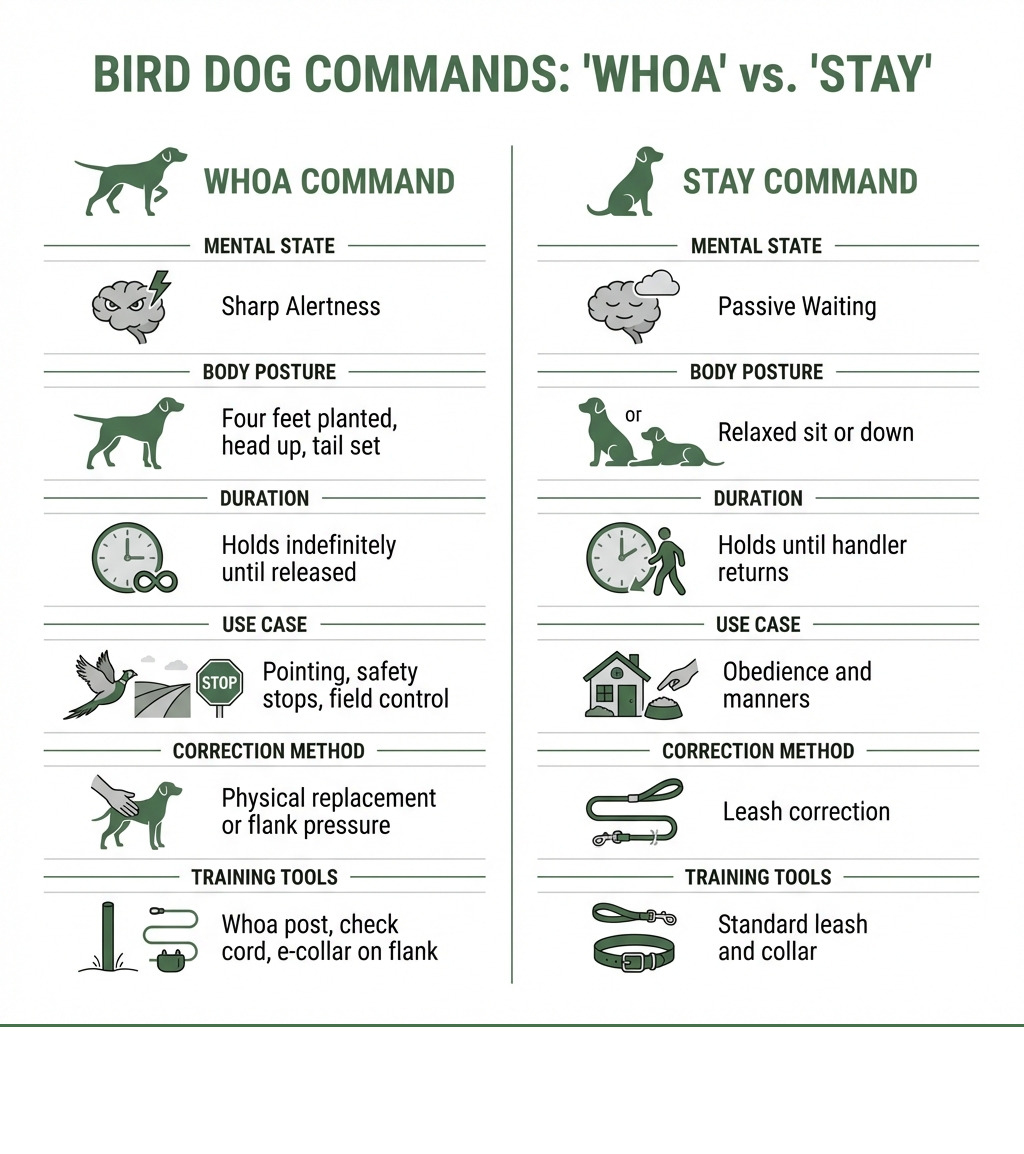
A well-trained “Whoa” means your dog stops cold, plants all four feet, and holds — no matter what’s happening around them. It’s not the same as “Stay.” It’s a sharper, more immediate command built for the field.
And here’s the thing: this command goes beyond hunting. It can stop your dog from bolting into traffic, tangling with wildlife, or flushing birds before you’re ready. Ronnie Smith of Ronnie Smith Kennels, who has trained thousands of bird dogs, considers “Whoa” the single most important command a pointing dog will ever learn. It’s hard to argue with that.
The good news? With the right method, most dogs get the basics in under a week. Full steadiness in the field takes about a month of consistent work — but the payoff is a dog that’s a genuine joy to hunt behind.
This guide walks you through everything: puppy starts, gear, step-by-step methods, and field proofing. Let’s get into it.
Whoa training a bird dog basics:
- Basic gun dog training
- Gun dog e-collar training
- Hunting Dog Training
The Foundation of Whoa Training a Bird Dog
At its core, “whoa” simply means stop and stand still. While that sounds easy, it is actually one of the hardest things for a high-energy bird dog athlete to do. These dogs are domesticated predators with a deep-seated instinct to chase. Whoa training a bird dog is the process of channeling that predatory energy into a composed, steady point.
Before we even think about birds, we focus on composure. A dog that is frantic or “bouncy” in its daily life will struggle when birds are flushing around its ears. We begin by shaping the dog’s mindset. This means requiring the dog to stand still during everyday moments—like before exiting a kennel door or waiting for a food bowl. By rewarding this calm behavior with our attention or a release, we build the impulse control needed for the field.
In our basic gun dog training, we emphasize that standing still is a skill that must be nurtured with patience. We use a lot of hands-on care during this phase. Simply stroking a dog’s back or tail while they are standing still helps them associate stillness with a positive, calm state of mind. This foundation ensures that when we finally introduce the “whoa” command, the dog already understands how to be composed and compliant.
According to experts at Gun Dog Magazine, you should prepare your dog for whoa breaking by focusing on a loose lead. A tight lead often causes a dog to pull back or become reactive. We want the dog to choose to stand still on a loose lead, which demonstrates true self-control rather than physical restraint.
Starting Whoa Training a Bird Dog with Puppies
You don’t have to wait until your pup is a year old to start. In fact, many trainers begin table standing as early as eight weeks. At this age, it isn’t about rigid discipline; it’s about comfort and touch.
We often place a puppy on a training bench or table—which saves our backs and gives us better control. While the pup stands there, we gently pet them, steady their legs, and perhaps even set their tail. This helps the puppy get used to being handled in a standing position. Keep these sessions short, maybe 10 to 30 seconds, and always end with praise and tail wags.
During these early stages, many pros suggest using non-verbal cues. You are simply teaching the behavior of standing still. Once the puppy hesitates to move when you take your hands away, you can start softly layering in the word “whoa.” Using a soft voice now means you won’t have to yell later when you’re out in the Texas brush.
Advanced Whoa Training a Bird Dog in the Field
Once the basics are solid, it’s time for the “ranch adventure” to get a bit more serious. Advanced whoa training a bird dog involves moving from the backyard to the hunting field. This is where we introduce birds, but we do it carefully to avoid making the dog “bird shy.”
We often use bird launchers to teach steadiness. If the dog tries to “creep” or flush the bird themselves, we launch the bird before they reach it. This teaches the dog that they cannot catch the bird by chasing; the only way to keep the bird around is to stand perfectly still. This transition helps the dog shift from a visual chaser to a scent-based hunter.
For those interested in competitive field trials or just a perfectly “broke” dog, this leads to being steady to wing and shot. This means the dog remains in a “whoa” position from the moment the bird flushes until after the gun is fired and the bird hits the ground. You can find more details on these high-level skills in our guide to advanced training for pointers. Staying updated on the Quail Hunting Forecast can also help you plan where to put these advanced skills to the test.
Must-Have Gear for the Ranch
To get the best results, you’ll need a few specialized tools. We believe in high-quality gear that provides clear communication without being overly harsh.
- Check Cord: A 10-to-20-foot stiff rope is your lifeline. It allows you to maintain control at a distance without the dog feeling like they are on a short leash.
- Whoa Post: A simple stake in the ground with a soft rope. It provides mechanical “flank pressure” that naturally encourages a dog to stop.
- Training Table or Bench: Essential for early puppy work and for correcting posture without bending over.
- Suitcase Handle: A small loop on the lead that allows you to easily pick up the dog’s feet and replace them if they move.
- Whoa Mat: A specific mat or piece of turf that acts as a “safe zone.” The dog learns that as long as they stay on the mat, the pressure stays off.
- E-Collar: Used only after the dog fully understands the command. It’s like a “remote check cord” for off-lead work in wide open spaces.
Step-by-Step Training Methods
There are several ways to approach whoa training a bird dog, and often the best method is the one that fits your dog’s specific temperament.
The Bench Method
This is the classic starting point. Place the dog on a bench and say “whoa.” If the dog moves even an inch, pick them up and put them back exactly where they were. Most dogs figure this out in less than a week. The key is physical replacement—manually moving the dog back to the “whoa” spot every single time they break.
The Suitcase Handle Technique
When walking your dog on a lead, use a “suitcase handle” loop. If you say “whoa” and the dog lunges forward, use the loop to lift all four paws off the ground and set them back down. This “startles” the dog into compliance more effectively than a simple tug on the neck.
The Whoa Post vs. Jog and Drop
| Method | How it Works | Best For |
|---|---|---|
| Whoa Post | A rope around the flank applies pressure when the dog moves forward. Pressure stops when the dog stands still. | Teaching the “meaning” of the stop through self-correction. |
| Jog and Drop | You jog with the dog, stop suddenly, and “drop” them into a stand if they keep going. | Building quick, sharp reactions and handler focus. |
Once the dog understands the mechanical pressure of the flank rope, you can transition to whistle conditioning. A single sharp blast on the whistle can become the cue for “whoa,” which is much easier to hear in the wind than a human voice. For the final stages of steadiness, see our guide on wing and shot training.
Troubleshooting and Common Pitfalls
Even the best trainers run into snags. Here are a few things to watch out for:
- Repeating Commands: This is the most common mistake. If you say “whoa, whoa, whoa,” your dog learns they don’t have to listen the first time. Say it once. If they move, correct them physically.
- Bird Shyness: If you are too harsh with corrections while the dog is looking at a bird, they might associate birds with pain. Always build the foundation of “whoa” away from birds first.
- Sticky Dogs: Sometimes a dog gets so worried about moving that they won’t hunt out in front of you. Limit your “whoa” sessions to 2 or 3 per day to keep the dog’s drive high.
- Rushing the Process: Don’t skip the yard work. A dog that won’t “whoa” in a quiet Lakeway backyard definitely won’t do it when a covey of quail explodes in front of them.
If you live in busier areas like Steiner Ranch or Westlake, use the environment to your advantage. Proof your “whoa” command at a local park with squirrels and pigeons. If your dog can hold a “whoa” while a squirrel runs past, they are ready for the field.
Common Questions from Fellow Hunters
What is the difference between ‘Whoa’ and ‘Stay’?
“Stay” is an obedience command that usually means “wait here until I come back to get you.” “Whoa” is a field command that means “stop moving right now and stand still until I give you a release or a different command.” A dog in “whoa” should be alert and standing, whereas “stay” is often done in a sit or down position.
At what age should I start formal whoa training?
While you can do “fun” standing work at 8 weeks, formal whoa training a bird dog with a check cord and corrections usually starts around 5 or 6 months. This is when the dog has the mental maturity to handle a bit of pressure.
How do I transition from a check cord to an e-collar?
Only move to the e-collar once the dog is 100% reliable on the check cord. Start by putting the e-collar on the dog’s flank (the same spot the whoa post rope sat). Give the command, and if they move, use a low-level continuous stimulation until they stop. Once they understand the “flank buzz” means “whoa,” you can move the collar back to the neck.
Bringing it All Together at the Ranch
Training a bird dog is a journey that requires patience, consistency, and a lot of wide-open space. At Pet Caddy, we understand that your dog is more than just a hunting partner—they’re family. Whether you are in Horseshoe Bay, Spicewood, or downtown Austin, we provide a “home away from home” where your dog can maintain their training while enjoying a true ranch adventure.
Our five-acre ranch offers the perfect stress-free environment for dogs to play and explore in small groups. Unlike crowded city kennels, we include hands-on human interaction and doggy daycare at no extra cost. Our pricing is completely transparent with no hidden fees, giving you peace of mind while you’re away.
If you’re looking to sharpen your dog’s skills, we offer tailored board and train options that focus on the same principles we’ve discussed here: composure, compliance, and confidence.
Schedule your pup’s advanced obedience training today and let us help you turn your bird dog into the steady, reliable partner you’ve always dreamed of. From Barton Creek to Marble Falls, we’re here to ensure your pup returns home with a tired body and a well-mannered mind.