Beyond the Tug: Why Force Fetching is Your Dog’s Best Friend
What Is Force Fetch Training? A Quick Answer Before We Dive In
Force fetch training is the process of teaching a dog to reliably pick up, carry, and deliver an object directly to your hand — every single time, no matter the distraction. It is a staple for many retriever breeds looking to sharpen their skills.
Here’s a quick snapshot of what it covers:
- What it is: A structured method that turns retrieving from a fun game into a reliable, obedience-level behavior
- Who it’s for: Retrievers, Pointing breeds (Vizslas, GSPs, setters), and any dog used for hunting or field work
- When to start: Typically around 7-9 months old, after permanent teeth are in and basic obedience is solid
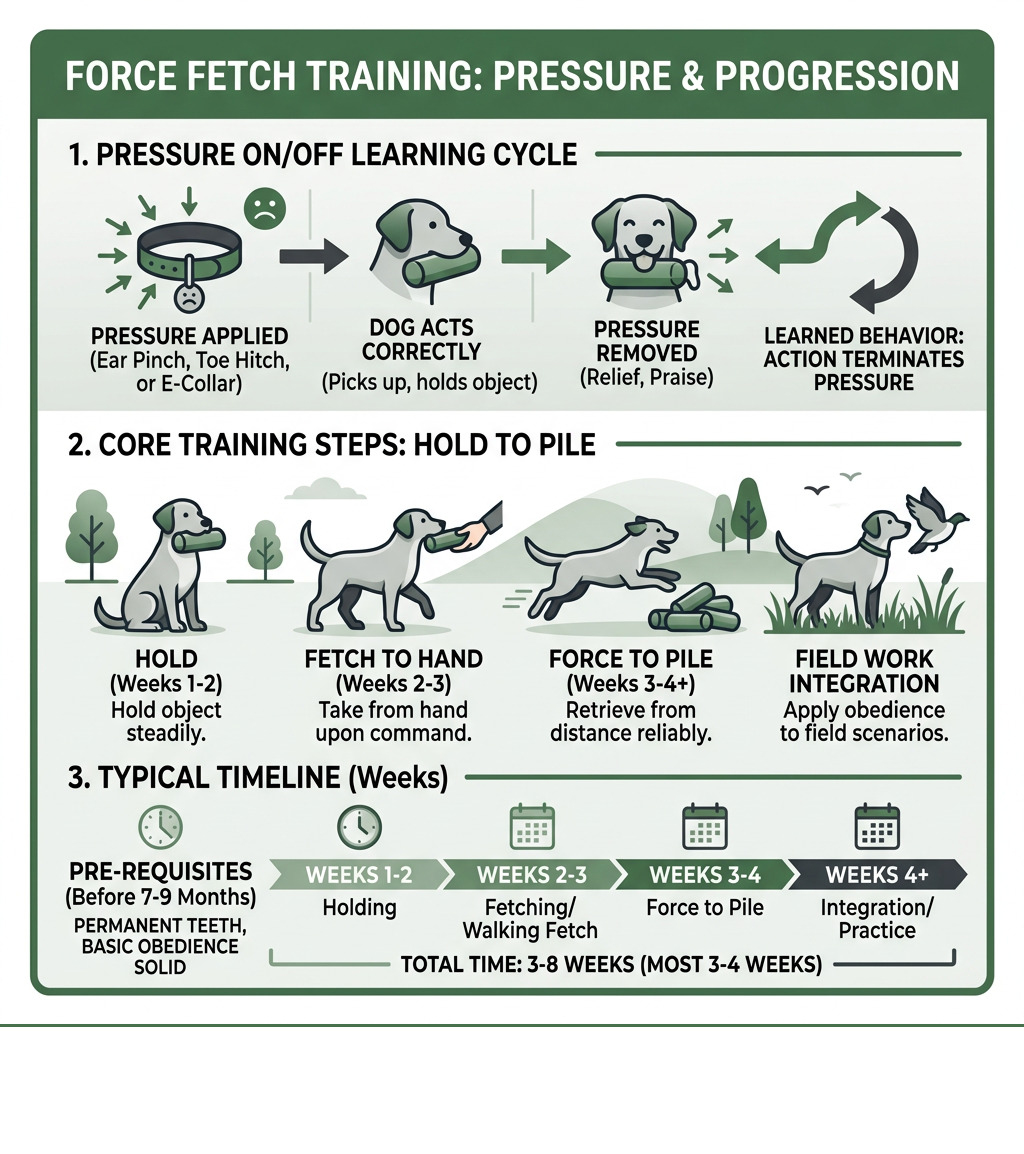
- How long it takes: Anywhere from 10 days to 8 weeks, depending on the dog — most land around 3-4 weeks
- Main methods: Ear pinch, toe hitch, e-collar conditioning, or positive reinforcement approaches
- Core steps: Hold -> walking fetch -> stick fetch -> force to pile
If you’ve ever watched a dog drop a bird just short of your hand, refuse a goose across a creek, or play keep-away instead of delivering cleanly — you already know the problem force fetch solves.
It’s one of those topics that sparks strong opinions among bird dog folks. Some say it’s unnecessary if your dog retrieves naturally. Others swear it changed everything about how their dog performs in the field. The truth? It’s less about whether your dog will fetch, and more about whether your dog must fetch — reliably, calmly, and completely — when it counts most.
The good news is that done right, force fetch isn’t harsh or traumatic. It’s a fair, step-by-step process built on a simple principle: pressure comes on, and the dog learns to turn it off by doing the right thing. That’s it.
This guide walks you through the whole process — from timing and prerequisites to each training step, common challenges, and how to pick the right method for your dog’s personality.
Relevant articles related to Force fetch training:
- training labrador retrievers for hunting
- Finished gun dog
- Gun dog e-collar training
Understanding Force Fetch Training and Its Purpose
At its heart, Force fetch training (also known as the “trained retrieve” or “force breaking”) is about reliability you can count on. We love our dogs’ natural drive to chase a ball, but in the hunting world, a retrieve is more than a game—it’s a job. This training converts retrieving from a “play” activity into an “obedience” command.
When a dog is force fetched, they learn to handle birds with a soft mouth, ensuring your precious cargo isn’t damaged. They learn to hold an object firmly but gently until you personally take it from them. No more dropping the bird at your feet or, worse, on the other side of a muddy creek. Whether you are navigating heavy cover in Spicewood or participating in high-stakes field trials, a force-fetched dog is a graceful, disciplined partner.
For many owners, the term “force” sounds a bit scary. However, in modern training, it’s really about teaching the dog how to turn off a small amount of discomfort (pressure) by performing a specific action. This process actually builds a deeper bond because it establishes you as a fair, consistent leader. To dive deeper into how this fits into a full program, check out our guide on beyond the basics training.
Why It Matters for Your Bird Dog
Whether we’re working with sturdy Labradors or elegant pointing breeds like Vizslas, consistency is king. Natural retrievers often do great until they hit a “hard factor”—like thick brush, cold water, or a heavy goose. Without Force fetch training, a dog might decide the effort isn’t worth the reward.
Formalizing the retrieve boosts your dog’s confidence. They no longer have to guess what you want; they have a clear, rehearsed response to the “fetch” command. This reliability is what makes a day in the field near Lake Travis or Bee Cave truly joyful. You can trust your partner to finish the job every time.
The Role of Basic Obedience in Force Fetch Training
Before we ever talk about “pressure” or “hold,” your dog needs a rock-solid foundation. Basic obedience—Sit, Stay, Heel, and Here—are the building blocks of our relationship. Think of it like this: if your dog won’t sit when it’s quiet in the backyard, they certainly won’t maintain focus during the mental rigors of force fetch.
We always recommend that a dog is fully collar-conditioned to basic commands before starting. This cultivates trust and ensures the dog understands how to learn from you. If you’re just starting out, our article on basic gun dog training is a great place to begin.
Getting Ready: Timing and Prerequisites
Timing is everything. You wouldn’t ask a toddler to run a marathon, and we don’t ask puppies to start formal force fetch too early. The golden rule is to wait until those adult permanent teeth are fully in.
Starting Force Fetch Training at the Right Age
Most trainers agree that 7 to 9 months old is the “sweet spot.” By this age, the dog has reached a level of mental maturity where they can handle focus for 10-15 minute sessions. More importantly, their mouth is no longer sore from teething. Attempting this at 3 or 4 months can actually ruin a dog’s trust and create a lifelong aversion to retrieving.
| Feature | Puppy Play Retrieve | Formal Force Fetch |
|---|---|---|
| Motivation | Purely fun and instinct | Obedience and command |
| Object | Soft toys, wings, small bumpers | Paint rollers, PVC, birds, dummies |
| Delivery | “Close enough” is okay | Directly to hand, sit and hold |
| Pressure | None (Positive only) | Controlled pressure on/off |
Navigating this phase requires patience. We want to ensure the dog is ready for a positive learning experience. For more on the early stages, see our tips on puppy to pointer training.
Step-by-Step Guide to the Force Fetch Process
At Pet Caddy, we often utilize a training table. It saves the trainer’s back, but more importantly, it keeps the dog focused and limits their ability to “escape” the lesson. Here is the general flow of the process.
Mastering the Hold and Walking Fetch
- The Hold: We start by teaching the dog to calmly hold an object. We often use a paint roller—it’s soft, inexpensive, and has a texture dogs don’t mind. We place it in their mouth, say “Hold,” and support their chin. The goal is a calm, steady grip without chewing or rolling the object.
- The Ear Pinch: Once “Hold” is understood, we introduce the concept of “Fetch.” We apply a small amount of pressure to the dog’s ear (the ear pinch) while offering the bumper. The moment the dog opens its mouth to take the object, the pressure stops. This is the “lightbulb” moment: Doing what the human wants makes the discomfort go away.
- Walking Fetch: Once the dog is reaching for the bumper on the table, we move to the ground. We walk with the dog at heel and occasionally drop the bumper. The dog must pick it up on command without breaking stride.
- Stick Fetch and Force to Pile: We eventually add a “stick” (a light tap) to reinforce the command and progress to “Force to Pile,” where the dog is sent to retrieve multiple bumpers from a distance.
Our experienced trainers here in Austin can guide you through each thoughtful step, ensuring the pace matches your dog’s temperament. For more on advanced field work, check out our guide to wing and shot training.
Common Methods and Modern Approaches
Not every dog learns the same way. While the ear pinch is the classic standard, there are other ways to reach the same goal.
- The Toe Hitch: Some trainers use a small loop of cord around the dog’s paw to apply pressure. It’s an alternative for dogs that might be “ear shy.”
- E-Collar Conditioning: Many modern trainers transition the pressure from the ear to a low-level “nick” or “constant” stimulation on the e-collar. This allows for corrections at a distance later in training.
- The Hillmann Method: This approach focuses on high-drive, “fun” retrieves and uses very soft e-collar nicks to reinforce the “fetch” command early on. It’s often seen as a lower-stress alternative to traditional table work.
- Positive Reinforcement: While 100% positive-only retrieving can take longer to become “bulletproof” in the field, it is a great option for extremely sensitive breeds.
Troubleshooting Resistance in Force Fetch Training
It’s perfectly normal for a dog to resist at some point. They might “clam up” (tighten their jaw) or even try to paw at the bumper. This isn’t usually defiance; it’s often a sign of confusion.
The key is persistence and patience. If the dog struggles, we simplify the task. We might go back to a supported “Hold” for a few reps to rebuild confidence. Reading your dog’s cues is vital. If they are getting too stressed, we end the session on a high note with a simple command they know well. For help choosing the right path, see our article on choosing the right training program.
Frequently Asked Questions about Force Fetching
How long does the process typically take?
Every dog is an individual. On the ranch, we’ve seen some “superstars” grasp the concept in 10 to 12 days. However, a typical timeline is 3 to 6 weeks. Some stubborn or sensitive dogs might take 8 weeks or more. It’s never a race; rushing often creates “holes” in training that show up later during hunting season.
Is force fetch necessary for natural retrievers?
Many Lab owners ask this. Your dog might fetch a ball 1,000 times in the backyard, but will they fetch a wounded, flapping goose in a freezing creek when they are tired? Force fetch training ensures unwavering reliability. It gives you a “remote control” to handle distractions and ensures your dog meets professional standards.
Does it work for pointing breeds like Vizslas or GSPs?
Absolutely. In fact, pointing breeds often benefit more from force fetch because their retrieving instinct isn’t always as “hard-wired” as a Lab’s. It is a requirement for advanced NAVHDA testing and makes for a much more versatile upland hunting companion. We simply tailor the pressure to suit the “softer” temperament of these breeds.
Conclusion
At Pet Caddy, nestled on our beautiful five-acre Austin ranch, we believe in training that feels Like Home. We know that your dog isn’t just a hunter; they’re a family member. By providing wide-open spaces, small groups, and hands-on care, we create a stress-free environment where every dog can thrive.
Whether you’re in Lakeway, Bee Cave, or right here in Austin, our board and train programs offer transparent pricing with no hidden fees—all-day play and human interaction are always included. Let us help your dog become the reliable, confident partner you’ve always dreamed of.
Schedule your pup’s stay and learn more about our dog training services